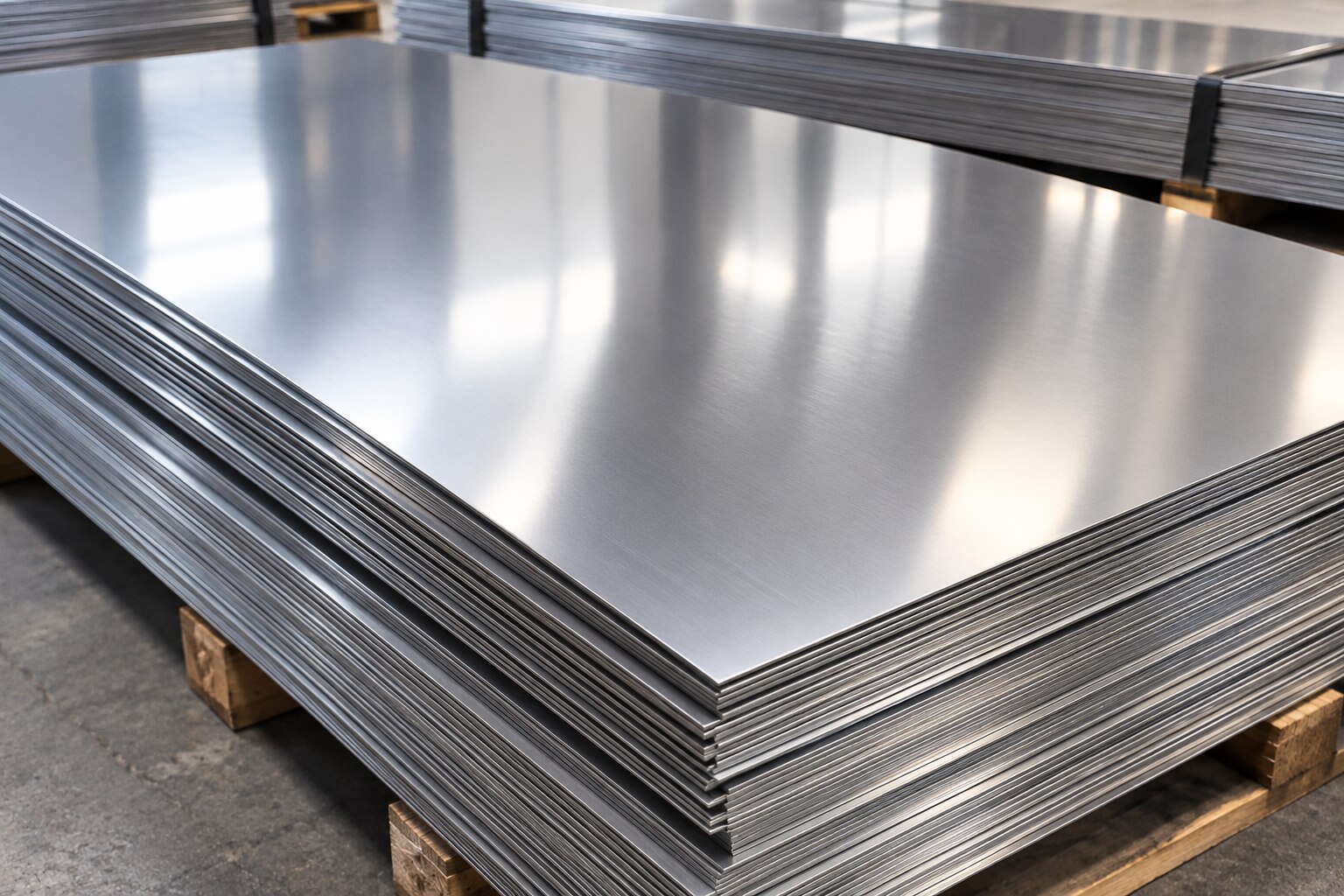
A quotation for “304 stainless sheet” does not yet tell you enough to release an order. You need to match the grade, product standard, thickness basis, dimensions, finish, edge condition, certification and delivery form to the way the material will be cut, formed, welded or installed. By the end, you will have a practical checklist for comparing quotations and receiving the correct material.
Key takeaways
- Specify grade, thickness, dimensions, tolerances and finish before comparing quotations.
- Choose grade against corrosion exposure, welding method and service temperature.
- Request the material certificate, heat number and delivery-condition details.
- Inspect sheet surfaces, edges, dimensions and protective packaging on arrival.
Turn the project drawing into a complete sheet specification
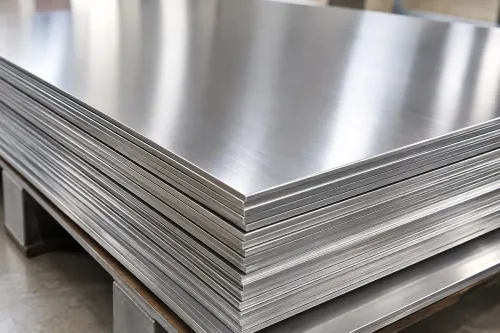
A quotation is only comparable after the drawing becomes a stainless steel sheet specification. “304 stainless sheet” leaves grade, thickness, dimensions, tolerances, finish, certification and delivery condition unresolved.
Use this SS sheet purchasing checklist before contacting suppliers:
1. State the governing standard: ASTM A240/A240M for material, with ASTM A480/A480M for dimensions, tolerances, finish, marking and testing. For pressure-containing work, name the construction code and confirm whether ASME SA-240, supplementary tests or impact testing applies.
2. Define the grade, thickness and corrosion allowance from the design. Record nominal thickness, permitted tolerance, sheet width, length, quantity and whether the design requires cut blanks or full sheets.
3. Specify surface finish, edge condition and flatness. Identify whether you need 2B, BA, No. 4 or another finish, plus sheared, slit or deburred edges. Require the applicable tolerance table rather than acceptance by a single caliper reading.
4. Describe fabrication conditions: minimum inside bend radius, rolling-direction requirements, annealed condition and mechanical-property data. Cold-rolled sheet can show different cracking and springback across versus along the rolling direction.
5. State the post-welding treatment and acceptance method. Include pickling, passivation or mechanical cleaning where heat tint or embedded iron could reduce corrosion resistance; prohibit carbon-steel-contaminated abrasives.
6. Require a material test certificate matching the heat number on each sheet or bundle. For European projects, specify EN 10204 Type 3.1 or Type 3.2 when purchaser validation is required.
Choose the stainless steel grade for exposure, welding and temperature
Choose the grade from the actual exposure, welding plan and operating temperature—not from the alloy number alone. 316 stainless steel offers better chloride resistance than 304 stainless steel sheet because molybdenum improves resistance to localized attack, but neither grade is immune to pitting, crevice corrosion or chloride stress-corrosion cracking.
| Grade | Exposure and temperature | Welding and magnetic behaviour |
|---|---|---|
| 304 | General indoor, architectural and many process environments; avoid sustained chloride exposure. | Good weldability; annealed material is usually nonmagnetic, but forming can induce magnetism. |
| 304L | Same corrosion range as 304, with lower sensitization risk after welding. | Prefer for welded assemblies; carbon limit is commonly 0.030% versus 0.080% for standard 304. |
| 316 | Chloride-bearing atmospheres, coastal exposure and mildly aggressive process service; confirm the actual concentration and temperature. | Better chloride resistance than 304; annealed material is usually nonmagnetic. |
| 316L | Welded chloride-exposed equipment and fabrications. | Lower carbon reduces sensitization risk; 316L stainless steel sheets still require controlled welding and post-fabrication cleaning. |
| 321 | Elevated-temperature service where carbide precipitation could damage a welded joint; confirm the design temperature and duration. | Titanium-stabilized; usually nonmagnetic when annealed. |
| 430 | Dry indoor, decorative or lightly corrosive service where lower cost and magnetic behaviour matter. | Ferritic and magnetic; less corrosion resistance and forming flexibility than austenitic grades. |
For welded fabrications, choose 304L stainless steel or 316L stainless steel when the lower carbon limit suits the design. Specify heat-tint removal and passivation after welding; embedded iron or heat tint can undermine corrosion performance. Confirm the applicable ASTM A240/A480 requirements before ordering.
Set thickness and tolerances from the design, not appearance
Select stainless steel sheet thickness from the design’s loads, unsupported span, forming method, buckling risk, weld shrinkage and corrosion allowance—not from how substantial the sheet looks. Confirm the required thickness with the design engineer, especially for pressure boundaries, structural panels and deep-drawn parts.
State whether you require sheet versus plate, because ASTM, EN and JIS standards can define these forms and their dimensional limits differently. Name ASTM A240/A240M or the governing equivalent, then reference ASTM A480/A480M for dimensions, finish, marking and tolerances. Quote nominal thickness, width, length and whether cut-to-size material is acceptable.
| Quotation detail | What to compare | Why it matters |
|---|---|---|
| Nominal thickness | The ordered value and permitted deviation | A cheaper nominal gauge can provide less usable metal |
| Thickness tolerance | Standard table, product form and rolling condition | Cold-rolled and hot-rolled material do not share every limit |
| Minimum guaranteed thickness | Whether the supplier guarantees a floor below nominal | Machining, forming and corrosion allowance consume material |
| Flatness tolerance | Maximum deviation over the stated measurement length | A dimensionally correct sheet can still need leveling before CNC cutting or assembly |
Ask each supplier to state the tolerance basis in writing rather than accepting “standard tolerance.” Compare width, length and flatness on the same standard and measurement method. If the drawing gives a tighter limit than ASTM A480/A480M, put that customer requirement directly in the purchase order; appearance cannot prove compliance.
Specify finish, edges and forming requirements before fabrication
Specify the finish, edge condition, forming direction and delivery protection on the purchase order; otherwise, fabrication may include avoidable deburring, straightening, polishing or rework.
| Finish | Surface and common use | Add to the specification |
|---|---|---|
| 2B finish | Smooth cold-rolled surface with a low-reflective appearance | State the required surface roughness, inspection lighting and allowable scratches |
| BA finish | Bright-annealed, more reflective surface | Define reflectivity, grain direction and repair limits |
| No. 1 finish | Hot-rolled, annealed and pickled surface with a dull appearance | Confirm whether scale staining or minor marks are acceptable |
| No. 4 finish | Abrasive-brushed directional surface for visible panels and equipment | State abrasive grit, surface roughness, grain direction and defect limits |
| No. 8 finish | Highly polished, mirror-like surface | Specify reflectivity, distortion limits, inspection distance and protective handling |
Name the edge you need: mill edge, slit edge, sheared edge, deburred edge, or laser- or waterjet-cut edge. Sheared and slit edges can carry burrs; laser cutting can leave a heat-affected zone, while waterjet cutting avoids heat but adds cleaning and drying work. A cheap full sheet can cost more after edge machining.
For forming, give the supplier the forming direction, minimum inside bend radius and bend orientation relative to rolling direction. Request tensile data and annealed-condition confirmation; stainless sheet can spring back or crack differently across and along the rolling direction.
Specify PVC protective film, adhesive type, removal temperature and maximum storage duration. Confirm whether it can remain during bending or laser cutting, and remove it before welding or other hot work to prevent residue, trapped moisture and discoloration.
Verify the standard, certificate and condition at delivery
Accept the delivery only when the paperwork, markings and physical condition tell the same story. A quotation should name ASTM A240/A240M or EN 10088-2, plus ASTM A480/A480M for dimensions, tolerances, finish and marking. For pressure equipment, identify the construction code and specify ASME SA-240 where required; ASTM material certification alone does not prove code compliance.
1. Match every bundle or sheet marking to the purchase order: grade, thickness, width, length, finish, edge condition, standard and heat number. Reject unidentified material until traceability is restored.
2. Match the material test certificate to that heat number. Request an EN 10204 Type 3.1 Type 3.2 material test certificate when European documentation applies; Type 3.1 comes from the manufacturer, while Type 3.2 adds independent or purchaser representative validation. A generic 304 certificate is not evidence for your sheets.
3. Perform positive material identification, or PMI, using XRF at receiving. X-ray fluorescence can separate many stainless grades, but it does not reliably measure carbon, so confirm 304 versus 304L or 316 versus 316L through heat analysis or optical-emission spectroscopy.
4. Inspect for dents, scratches, rust, heat tint, burrs, warped edges and moisture staining. For welded work, confirm the specified pickling passivation or cleaning acceptance method; carbon-steel tools can leave free-iron contamination.
Give SMD Impex this checklist before dispatch so discrepancies are resolved before fabrication, not after cutting.
Frequently asked questions
What details should a stainless steel sheet specification include?
State the grade, thickness, sheet dimensions, tolerances, surface finish, edge condition, certification and delivery condition.
How do you choose a stainless steel grade for fabrication?
Match the grade to corrosion exposure, welding requirements and operating temperature rather than choosing by appearance alone.
Why must sheet thickness and tolerances come from the design?
Design calculations determine the required thickness, while tolerances control fit, weight, forming performance and fabricated dimensions.
What finish, edges and forming details should you specify?
Specify the surface finish, cut or mill edges, flatness needs, bending radius and other forming requirements before fabrication.
Which documents and checks matter when stainless steel sheets arrive?
Verify the stated standard, material test certificate, heat or batch number, dimensions, surface condition and packaging at delivery.