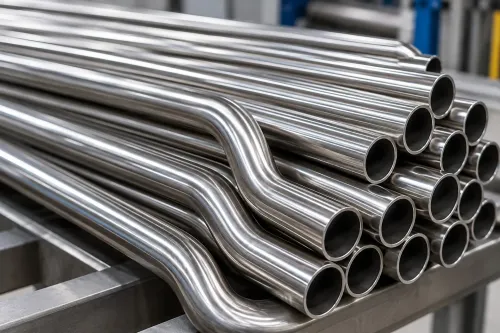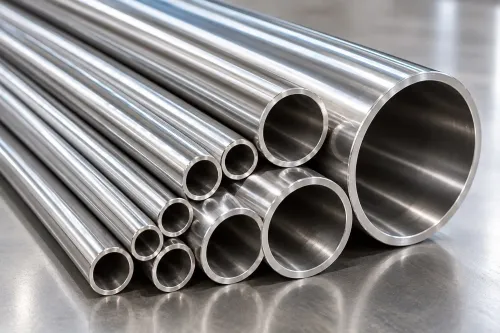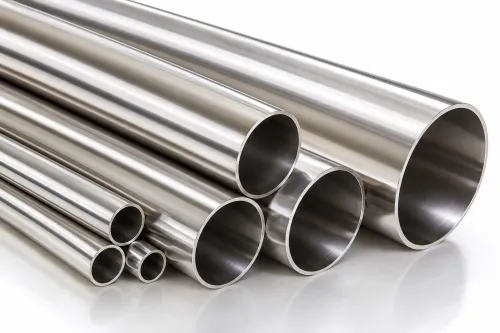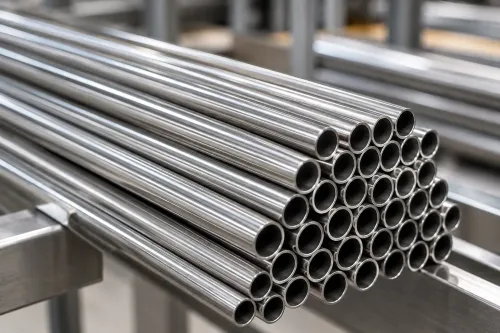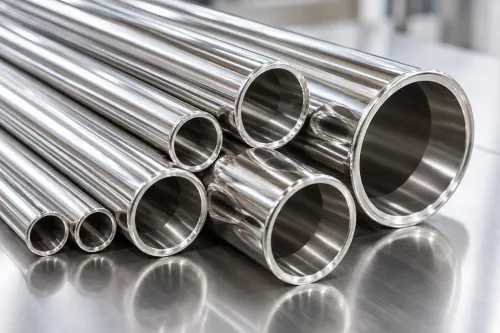
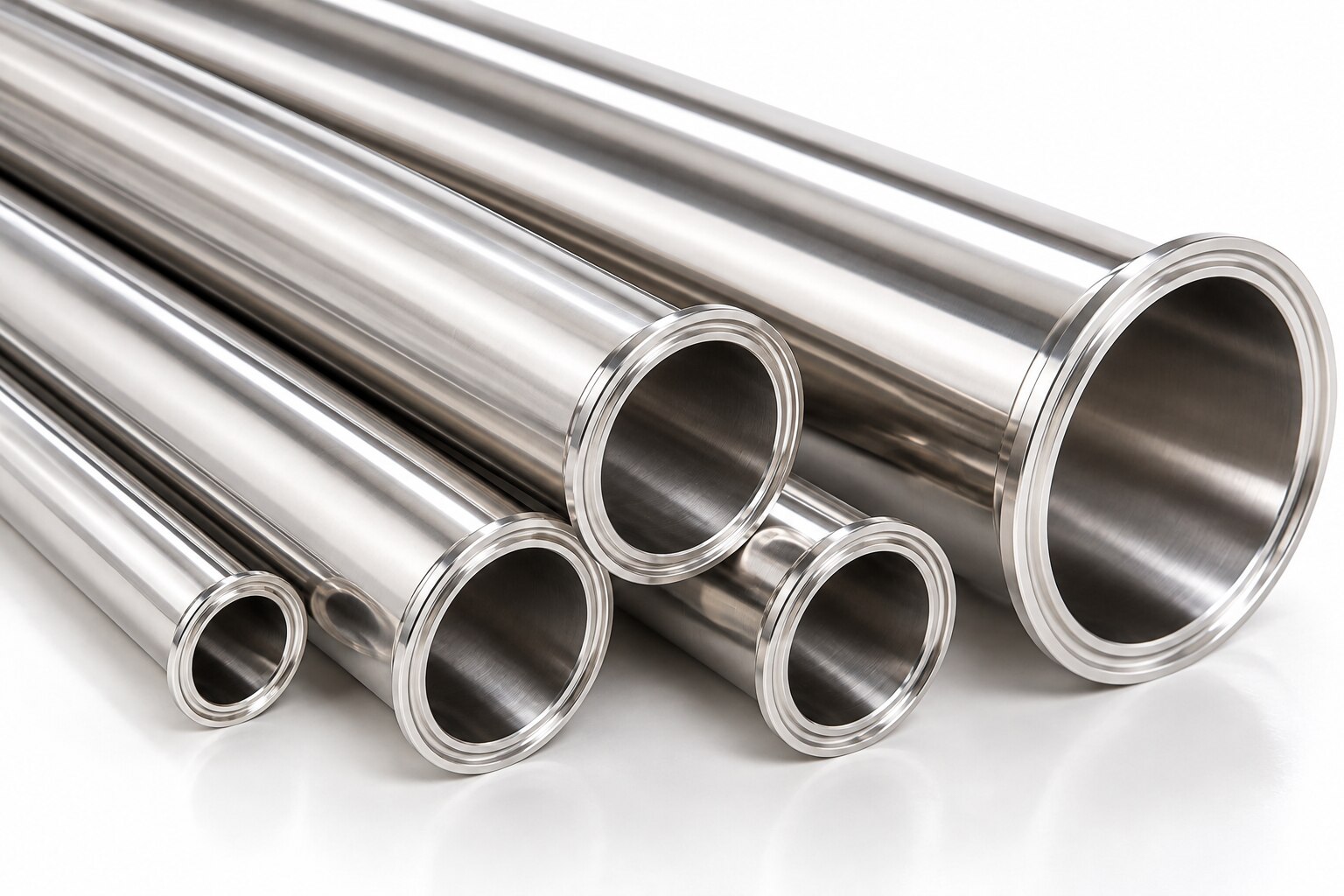
A tube can have a polished appearance and still trap product, retain cleaning fluid or fail at a welded joint. By the end, you will be able to specify sanitary tubing by standard, grade, finish, dimensions, fabrication controls and traceability, then judge whether it suits your process and cleaning regime.
Key takeaways
- Specify a low-Ra internal finish to reduce soil retention and microbial harborage.
- Match the tube grade and standard to the fluid, temperature and cleaning chemistry.
- Check welds, dimensions and fittings for complete CIP and SIP drainage.
- Require heat numbers, material certificates and inspection records before installation.
How Tube Surfaces and Geometry Prevent Contamination
A smooth internal surface reduces soil retention, while low roughness limits microbial harborage. Surface roughness Ra is the arithmetic average deviation from the mean surface line, reported in micrometres (µm).
Specify it for the product-contact surface, not merely the outside finish, which may be defined by grit, such as up to 240 grit, or by Ra in µm where applicable.
A mechanically polished surface can look bright without proving that the bore meets the required finish. A low Ra reading alone does not prove cleanability: internal welds, heat tint, pits, scratches, inclusions and sharp transitions can trap residue. Crevice-free geometry and drainability matter too.
Dead legs, threaded joints, ferrules, valve cavities and poorly aligned fittings can retain product even when the straight tube is smooth.
| Option | Typical limitation | Product-contact implication |
|---|---|---|
| Sanitary tube | Controlled finish, geometry and documentation | Designed for hygienic service |
| Ordinary welded pipe | Schedule dimensions and weld condition may not meet sanitary requirements | Sanitary tube versus ordinary pipe is not an interchangeable choice |
| Seamless tube | No longitudinal weld, but finish and geometry still require verification | Not automatically hygienic |
| Instrumentation tube | Small-bore control service focus | May lack sanitary finish and connections |
| Hydraulic tube | Pressure-service focus | May lack hygienic documentation and drainable geometry |
A general-purpose tube can lack the finish, dimensional control or documentation required for product-contact service. Use borescope inspection for inaccessible bores when required by the process owner or governing standard, and retain weld documentation covering purge, acceptance and post-weld treatment.
Which Standard, Grade and Surface Treatment Fit the Process
Choose the standard from the process, not from the tube label. ASTM A270/A270M, often called ASTM A270, covers welded and seamless austenitic stainless-steel tubing for dairy and food applications, including dimensions, finish, workmanship and testing.
| Standard | Primary focus | Use it for |
|---|---|---|
| ASTM A270/A270M | Food and dairy tubing requirements | General sanitary tube procurement |
| ASME BPE | Bioprocess materials, dimensions, finishes, fabrication, examination, inspection and testing | Pharmaceutical and biotechnology systems |
| 3-A Sanitary Standards 3-A | Hygienic food and dairy equipment | Equipment accepted for cleanable product-contact service |
| EHEDG guidance | Hygienic design and cleanability | Evaluating geometry, drainage and cleaning performance |
304 or 304L suits many mild food and beverage services. Select 316 or 316L when chlorides, sanitising chemicals, temperature or exposure time increase pitting and crevice-corrosion risk. Molybdenum improves 316 resistance, but neither grade is immune to chloride attack.
The L grade lowers carbon and limits chromium-carbide sensitisation after welding; it does not replace proper weld cleaning.
Passivation chemically restores a chromium-rich passive surface; it does not remove scale. Pickling removes oxide and heat tint, so heat-tinted welds need suitable cleaning or pickling before passivation. Electropolishing removes a thin surface layer, reducing roughness and improving cleanability. ASTM A967/A967M covers chemical passivation treatments, including nitric- and citric-acid methods, plus verification tests.
Specify the treatment and evidence rather than accepting “sanitary finish” alone.
How Dimensions, Welding and CIP/SIP Design Affect Performance
Specify sanitary tube by outside diameter, wall thickness, nominal size, gauge, cut length and dimensional tolerances; state actual millimetres when using gauge, because gauge systems vary. Do not substitute a pipe schedule for sanitary dimensions. Check pressure, temperature, vacuum, external loads and allowable stress against the governing design code; hygiene does not prove structural adequacy.
- Select welded tube for controlled, economical runs when the longitudinal seam meets the specification; select seamless tube when the design code, forming requirements or service demands it. For field joints, require orbital welding, verified weld alignment, controlled internal weld bead, documented purge gas, and acceptance criteria covering cracks, incomplete fusion, porosity and heat tint. Specify post-weld pickling or passivation, visual or borescope inspection, and weld records.
- Design routing for validated CIP: provide slope and drain points, adequate support spacing, full spray coverage, compatible cleaning chemicals, cleaning temperature and validated flow velocity. Oversizing reduces pressure drop but lowers velocity at a fixed flow rate, which can reduce wall shear and leave soil behind. Avoid stagnant sections; define dead-leg L/D using the governing standard’s measurement method.
- CIP circulates cleaning solution; SIP uses steam or another validated sterilising cycle. Manual disassembly remains necessary for valve cavities, removable connections and any area the validated procedure cannot reach.
| Welded | Longitudinal seam requires purge, bead and inspection controls | Controlled sanitary fabrication |
|---|---|---|
| Seamless | No longitudinal weld, but dimensional and surface verification remains necessary | Code or forming demands justify it |
| CIP | Chemical cleaning with flow, temperature and spray coverage | Cleanable closed systems |
| SIP | Validated steam sterilisation | Systems requiring sterilisation after cleaning |
What Evidence Proves the Tube You Ordered Is the Tube You Installed
Accept the tube only when its identity survives three links: tube marking, packing label and installed spool. Request an EN 10204 3.1 material test certificate showing the heat number or batch number traceability, chemical composition and mechanical properties, plus a surface-finish record, dimensional inspection, weld procedure or orbital-weld records, passivation record and certificate of conformity.
At receiving, record each tube’s marking against its packing label and mill certificate before cutting. Transfer that identity to the spool drawing, weld map and installation record; a spool without its source heat number is not traceable.
Check every delivery for:
- Dents, scratches, discoloration, contamination and ovality
- Incorrect grade, mismatched heat numbers and damaged protective caps
- Capped ends, clean wrapping and clean packaging
- Dry storage, separation from carbon steel and impact protection
Reject exposed ends, rust transfer or carbon-steel contact before installation. Do not accept “premium quality” as evidence.
Compare suppliers using measured results, not adjectives.
| Evidence | What to compare | Why it matters |
|---|---|---|
| Finish | Recorded internal Ra and method | Confirms the product-contact surface |
| Dimensions | Actual diameter, wall and tolerances | Prevents fit-up and drainability failures |
| Welding | Weld condition, procedure and orbital-weld records | Controls heat tint and joint defects |
| Traceability | Heat links from tube to spool | Supports investigations and recalls |
| Delivery | Packaging cleanliness and lead-time reliability | Protects clean stock and schedule |
Evaluate SMD Impex by this same checklist, including grade, standard, weld condition and records, rather than marketing language.
Related product
 | Stainless Steel Sanitary Tubes Stainless Steel Sanitary Tubes Stainless Steel Sanitary Tubes are precision-engineered tubes manufactured to meet stringent hygiene standards for industries where cleanliness and... View product → |
When Sanitary Tubing Is the Right Investment—and When It Is Not
Sanitary tubing earns its cost when a product-contact failure costs more than the tube: food and beverage processing, dairy processing, pharmaceutical piping and biotechnology systems demand cleanability, corrosion control, drainability and documented traceability. It is not automatically correct for non-product-contact utility lines, severe mechanical service, or conditions beyond the selected grade and wall thickness.
| Industry | Finish and documentation | Cleaning and sterilization expectations |
|---|---|---|
| Food and beverage processing | Smooth, corrosion-resistant finish; ASTM A270 records | CIP and documented cleaning checks |
| Dairy processing | Tight finish and drainability; heat traceability | Frequent caustic and acid CIP |
| Pharmaceutical piping | Defined Ra, weld records and full traceability; ASME BPE basis | Cleaning validation, SIP and hygienic validation |
| Biotechnology systems | High documentation, controlled welds and defined surface treatment | Validated CIP/SIP and batch-changeover evidence |
| Cosmetics processing | Finish depends on oils, pigments and fragrances; lot records | CIP plus swab or rinse verification |
| Breweries | Corrosion-resistant finish and clean welds | Repeated caustic, acid and sanitiser cycles |
Use a procurement checklist that names:
- Grade; ASTM A270 or ASME BPE basis; welded or seamless construction; dimensions and tolerances; internal Ra and measurement method; finish treatment; weld condition; inspection records; packaging; acceptance criteria.
Sanitary tube is the wrong choice if pressure design, temperature design or vacuum service requires a different wall calculation or alloy. Poor selection creates extra cleaning cycles, failed swab or rinse tests, rework, rejected batches, difficult cleaning validation and post-installation replacement.
Frequently asked questions
How do tube surfaces and geometry prevent contamination?
A smooth internal surface reduces soil retention, while low roughness Ra limits microbial harborage. Tube geometry, joints and drainage paths also affect whether cleaning fluid reaches and clears every area.
How do you choose a sanitary tube standard, grade and surface treatment?
Choose the standard first, then match the stainless steel grade and internal surface treatment to the process fluid, temperature, cleaning chemicals and hygiene requirements. Specify the finish by a measurable Ra value rather than using only terms such as polished.
How do dimensions, welding and CIP or SIP design affect tube performance?
Tube diameter, wall thickness, weld quality, alignment, slope and fitting design determine flow, cleanability and drainability. Inspect welds and design the system so CIP fluid and SIP steam reach all product-contact surfaces without dead legs.
What documents prove that the tube ordered is the tube installed?
Compare the tube marking with the purchase order and material test certificate. Record the heat number, grade, dimensions, surface finish and weld or inspection records through receiving, fabrication and installation.
When is sanitary tubing the right investment?
Use sanitary tubing when product-contact hygiene, cleanability, sterilisation or traceability matters. It is a poor fit when the service is non-hygienic and standard industrial pipe meets the required pressure, corrosion and maintenance needs at lower complexity.