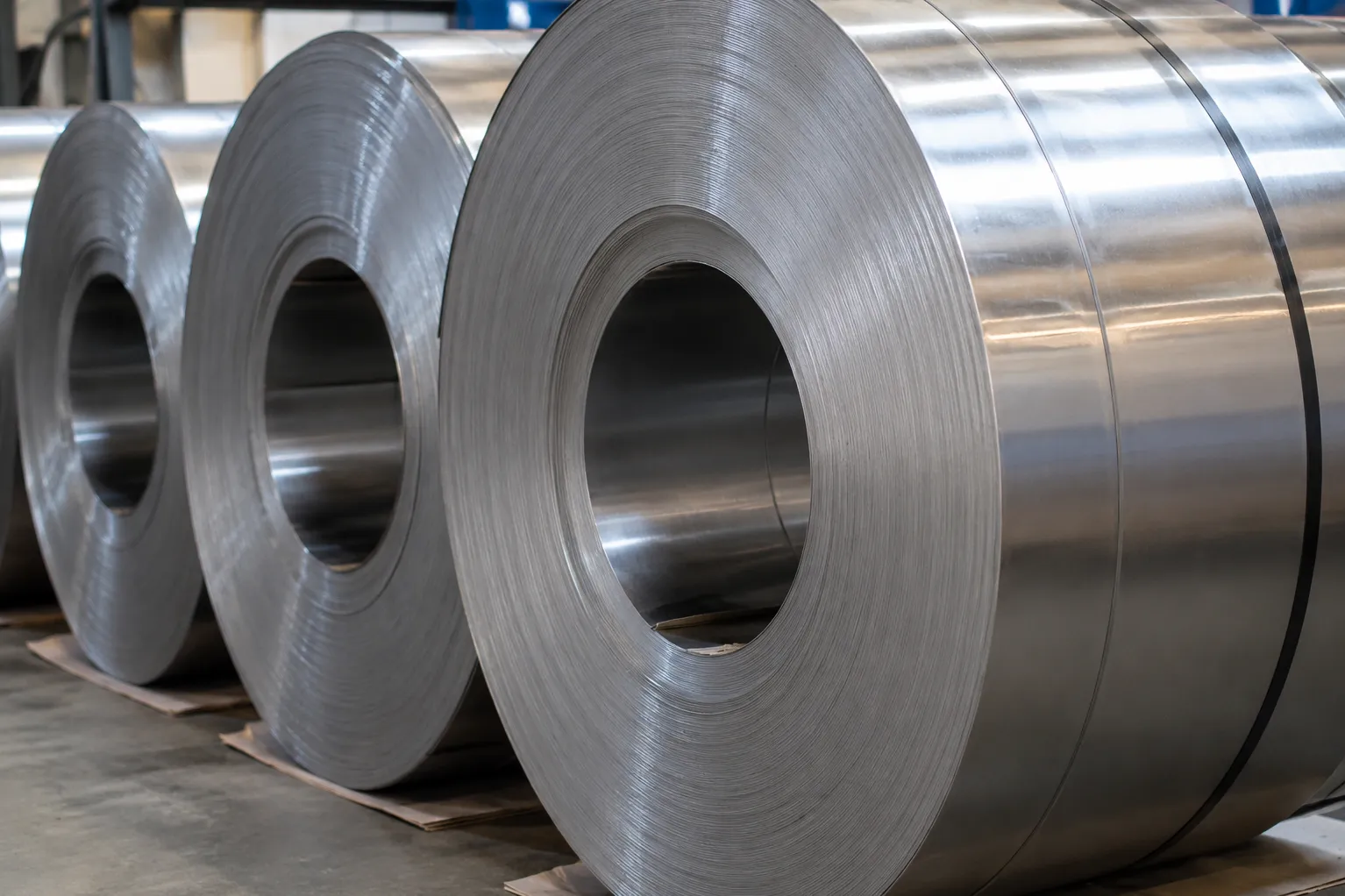
Stainless steel coils are used by manufacturers that require a continuous supply of flat material for cutting, forming, stamping and automated production. They are commonly processed into utensils, automotive parts, panels, tubes, enclosures, roofing products and industrial components.
SMD Impex supplies SS coils in Gujarat for manufacturing and fabrication requirements. Buyers comparing coil options should evaluate more than the price per kilogram because grade accuracy, thickness tolerance, width and surface condition directly affect production efficiency.
Why Manufacturers Choose Coil Material
Coils support continuous or high-volume manufacturing. They can be fed into slitting, blanking, roll-forming and stamping lines, reducing the need to handle individual sheets.
Depending on production requirements, coils may offer:
- Faster material feeding
- Consistent component production
- Reduced manual handling
- Better material utilisation
- Flexible slit-width options
- Suitability for automated processing
- Lower interruption between production cycles
These benefits depend on the coil matching the capacity and settings of the processing equipment.
Hot-Rolled and Cold-Rolled Coils
Hot-rolled stainless steel coils are processed at elevated temperatures. They are generally used for heavier industrial applications where thickness and strength are more important than a highly refined surface.
Cold-rolled coils undergo additional processing at lower temperatures. They usually provide closer dimensional tolerances and smoother finishes, making them suitable for appliances, precision components, decorative products and light fabrication.
A cold-rolled product is not automatically necessary for every application. The required thickness, surface quality and forming operation should determine the choice.
Coil Specifications That Affect Production
A complete coil enquiry should include:
- Stainless steel grade
- Required thickness
- Coil width
- Coil weight
- Internal diameter
- Outer diameter limit
- Edge condition
- Surface finish
- Protective film requirement
- Thickness and width tolerance
Coil weight and internal diameter must be compatible with the buyer’s decoiler and handling system. A coil that exceeds equipment capacity can create safety and production difficulties even if its grade and width are correct.
Mill Edge and Slit Edge
Mill-edge coils retain the original edges produced during rolling. They may be suitable when the material will undergo further trimming.
Slit-edge coils are cut to a defined width using a slitting line. Edge quality becomes particularly important for roll forming, stamping and applications where the edge remains part of the finished product.
Buyers should confirm width tolerance and burr direction where edge condition affects the next production stage.
Comparing Suppliers and Quotations
When comparing quotations, ensure that each supplier has priced the same grade, thickness tolerance, width, finish and coil weight. A lower quotation may reflect a wider thickness tolerance, different finish or edge condition.
Material documentation should also be evaluated. Heat-number traceability and mill test certificates can help quality teams verify chemical and mechanical properties.
Packaging is another practical consideration. Moisture-resistant wrapping, edge protection and stable supports help reduce damage during transit and storage. Coils should be kept in a dry area and handled using equipment designed for their weight.
Improving Material Utilisation
Manufacturers can reduce scrap by matching slit width to the component layout. Production teams should analyse trim loss, blank size and line settings before finalising the coil width.
Across Gujarat, stainless steel coils support industries ranging from utensils and appliances to engineering, automotive components and construction products. Accurate specifications help businesses maintain repeatability across long production runs.
Contact SMD Impex with your SS coil grade, thickness, width, weight and finish requirements. The team can assist Gujarat-based manufacturers in identifying coil material suited to their processing equipment and production plans.
Keywords